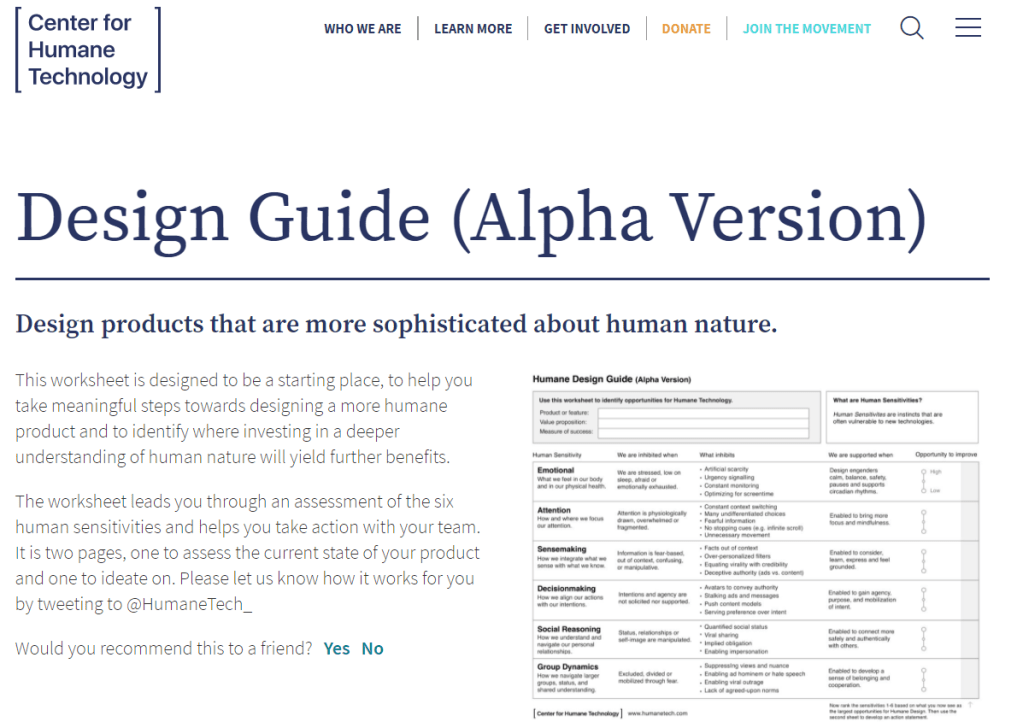
Although technology enables all industries, there is limited research that examines potential negative impacts of emerging technology, and whether or not a particular technology implementation is actually beneficial to its users. Humane Design is an approach to IT systems design that aims to support those wanting to prioritize human needs in human-computer interactions. The Centre for Humane Technology has defined Humane Design along six instinctive human sensitivities that are vulnerable to new technologies. These sensitivities are labeled: Emotions, Attention, Sense-making, Decision-making, Social Reasoning, and Group Dynamics (Humane Design Guide, 2020).
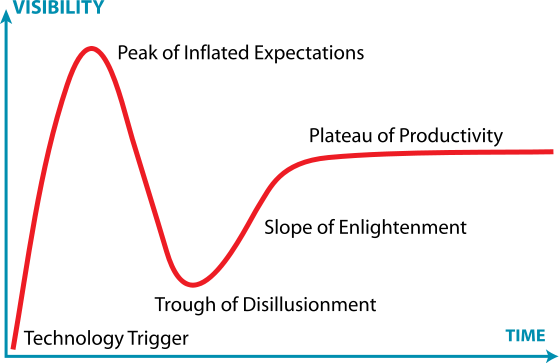
Technology is changing how people work, learn and live, yet it does not always meet our expectations. The Gartner Hype Cycle depicts the process of new technology emerging and being adopted using a line graph of expectations over time (“Hype Cycle Research Methodology,” n.d.). The cycle begins with innovation, is then followed by an increase of inflated expectations, then expectations drastically drop into a trough of disillusionment and finally end with a slight increase in the slope of enlightenment (“Hype Cycle Research Methodology,” n.d.). The hype cycle is normally applied to explaining the process of one new technology emerging, yet it could be indicative of a broader experience of ever-increasing technology disruption. The impacts of the current surge in technology integration are not yet known.
Steve Jobs once famously described computers as tools, like bicycles for the mind (Laurence, 2006). He considered the efficiency that human bodies gain when using a bicycle, similar to the efficiency human minds gain when using a computer (Laurence, 2006). If the value of technology is in increasing the efficiency of the human mind, than the examination of technology’s success can be done through an educational lens. An educational technology perspective explores how technology facilitates learning and the acquisition of new knowledge and understanding.
 peakHub